Forex vs CFD Trading: What You Actually Trade on Retail Platforms
A practical explanation of forex, CFDs, spot-style pricing, counterparty risk, leverage, and why product type matters before you deposit.
Many retail traders say they trade forex, but the product inside the account can vary. Some accounts offer spot-style foreign exchange. Many platforms offer contracts for difference, also called CFDs, on forex pairs, gold, indices, commodities, or crypto-related markets.
The difference matters because it affects regulation, pricing, leverage, counterparty risk, trading hours, and what you actually own. In many cases, you are not buying the underlying asset. You are trading a contract based on price movement.
Quick Answer
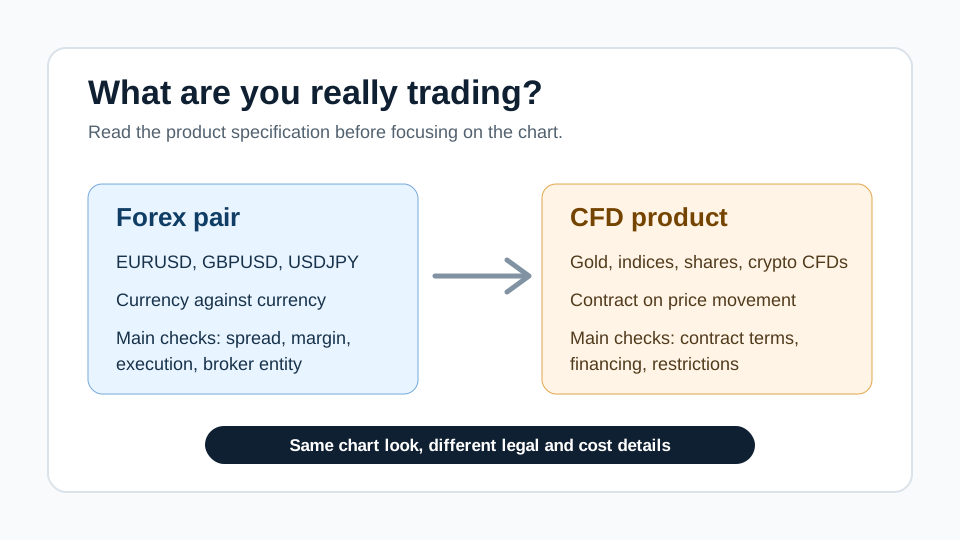
Forex trading usually means speculating on currency pair price movement. CFD trading means speculating on the price movement of an underlying market through a contract with a provider. Retail platforms often offer forex pairs and XAUUSD through CFD-style products depending on the broker and jurisdiction. Before trading, check the legal entity, product type, costs, leverage, and client protections that apply to your account.
What Forex Trading Means
Forex trading is the exchange of one currency for another. Retail traders usually speculate on the movement of pairs such as EURUSD, GBPUSD, or USDJPY. If EURUSD rises, the euro has strengthened against the dollar. If it falls, the euro has weakened against the dollar.
Retail forex accounts are usually leveraged. The trader deposits margin and controls a larger position. That creates opportunity and risk at the same time.
For a retail trader, the important question is practical: how does my broker provide this pair, what margin rules apply, and what happens if price moves against me quickly?
What CFD Trading Means
A CFD is a contract based on the price difference between entry and exit. If you trade a CFD on gold, you are not taking delivery of physical gold. If you trade a CFD on an index, you are not buying all the underlying shares. You are speculating on price movement through the broker's contract.
CFDs can be flexible, but regulators have repeatedly warned that they are complex and risky for retail clients. Leverage, spreads, overnight financing, and provider terms all matter.
| Feature | Forex pair | CFD product |
|---|---|---|
| Market exposure | Currency against currency | Price movement of an underlying market |
| Ownership | Usually no physical currency delivery for retail traders | No ownership of underlying asset |
| Instruments | EURUSD, GBPUSD, USDJPY | Gold, indices, commodities, shares, crypto-related markets |
| Main risks | Leverage, spread, slippage, broker risk | Leverage, provider terms, financing, counterparty risk |
| What to check | Broker entity and forex permissions | CFD terms, risk warning, costs, and restrictions |
| Typical extra detail | Pair convention and margin requirement | Contract size, financing, trading hours, and expiry rules if any |
What the Platform Label Can Hide
Two trades can look almost identical on a chart while being different products underneath. The platform symbol is only the front door. The product specification tells you the contract size, trading hours, minimum lot, margin, spread, and financing rules.
| Platform label | What it may mean | What to verify |
|---|---|---|
| EURUSD | Retail forex pair or forex CFD, depending on broker and region | Legal entity, spread, commission, leverage, margin close-out rules |
| GBPUSD | Major currency pair with broker-specific execution | Typical spread during London and New York sessions |
| XAUUSD | Gold priced in US dollars, often offered as a CFD | Contract size, point value, swap, margin, trading hours |
| US30 or GER40 | Usually an index CFD on retail platforms | Underlying reference, trading hours, financing, spread |
| Crypto pair | May be CFD, derivative, or another product type | Client eligibility, weekend rules, leverage, custody or no custody |
If the broker does not make the product specification easy to find, treat that as a reason to slow down.
Why XAUUSD Can Be Confusing
XAUUSD is often displayed beside forex pairs, but it represents gold priced in US dollars. Depending on the broker, you may be trading a CFD on gold rather than a spot metal product. The platform may still look similar, but the contract terms can differ.
This is why traders should read the broker's product specification. Check trading hours, minimum lot size, spread, swap, contract size, and margin requirement. A gold trade can behave very differently from a major forex pair.
If you are sizing a gold trade, read XAUUSD lot size risk and check the money value with the forex lot size calculator before placing live risk.
Regulation Depends on Your Account
Rules for forex and CFDs vary by country. A product available in one region may be restricted or unavailable in another. The same broker brand may route clients to different legal entities depending on residence.
Do not assume that a review written for one country applies to your account. Check the broker entity that will actually hold your funds and provide the product. Then compare that entity against public registers or regulator pages where possible.
Costs and Financing
Both forex and CFDs can include spreads, commissions, and overnight financing. Costs can differ by instrument. A major forex pair may have a tight spread, while an index or gold CFD may have different pricing and swap rules.
If a strategy holds positions overnight, financing costs can affect the result. If a strategy trades frequently, spread and commission can matter more. Always match the cost structure to the strategy style.
| Cost | Where it appears | Why it matters |
|---|---|---|
| Spread | Difference between bid and ask | Immediate cost at entry and exit |
| Commission | Fixed or per-lot charge | Important for active trading and raw spread accounts |
| Swap or financing | Overnight holding cost or credit | Can change long-held forex and CFD results |
| Slippage | Fill difference during fast movement | Can make losses larger than planned |
| Conversion cost | Currency conversion between account and instrument | Matters if account currency differs from profit currency |
Copy Trading Considerations
If you copy a strategy, confirm what product the strategy trades. A provider trading XAUUSD on one broker may not match your broker's gold contract exactly. Contract size, minimum lot, swap, spread, and trading hours can differ.
On TestedSignals, use the strategies page and broker information together. If you are comparing gold exposure, review pages such as TMGM Gold Buy + Chill DCB and EURUSD Ultima Markets with product terms in mind. You can also compare broker context from the brokers hub before connecting an account.
Questions to Ask Before Trading
Before opening a position, ask:
- Is this spot-style forex, a CFD, or another derivative?
- Which legal entity provides the account?
- What leverage and margin rules apply?
- What are the spread, commission, and overnight costs?
- Do I own the underlying asset?
- What happens if the broker changes trading conditions?
- Are there country restrictions or client protections?
- What product document or specification page explains the contract?
The label on the platform is not enough. The contract terms tell you what you are really trading.
CFD Day Trading vs Forex Day Trading
Searches often frame this as a product choice, but for day traders the practical differences come down to costs, instruments, and account rules rather than the label on the platform.
Intraday forex trading on a classic account usually means tight focus on a few currency pairs, spread-plus-commission costs, and no overnight financing if positions close before rollover. CFD day trading widens the instrument menu — indices, gold, oil, single stocks — but each product carries its own spread behavior, financing rules, and sometimes market-hours gaps that do not exist on 24/5 forex pairs.
Three checks matter most for day traders comparing the two:
- Cost per round trip. On majors like EURUSD, compare spread plus commission during the session you trade. On CFD indices or gold, spreads can widen sharply outside main exchange hours even when the platform stays open.
- Overnight financing. Day traders who occasionally hold past rollover pay swap on forex and financing charges on CFDs; both are visible in the product specification, and both can turn a marginal strategy negative.
- Execution during news. Index and commodity CFDs can gap or widen more than major forex pairs around scheduled releases. If your day trading strategy relies on tight stops, test the exact instrument during a news window on demo first.
Neither product is inherently better for day trading. Forex pairs offer consistency and round-the-clock liquidity; CFDs offer breadth. The deciding factor is whether the account's real costs and execution fit the specific strategy you run.
Related comparisons and guides
- Pepperstone vs IC Markets — regulated broker comparison for EU traders
- FBS vs Exness — fees, entities, and copy trading fit
- Copy trading guide — verify setup before connecting a live account
- Scam check guides — signal provider verification hub
Final Thought
Forex and CFDs can look similar on a chart, but the legal and practical details are different. A careful trader reads the product specification before focusing on entries. Knowing what you trade is the first layer of risk control.
FAQ
Is forex trading the same as CFD trading?
No. Forex trading focuses on currency pair price movement, while CFD trading uses a contract with a provider to speculate on an underlying market. Some brokers offer forex pairs through CFD-style products, so the account terms matter.
Do I own anything when I trade a CFD?
Usually no. A CFD gives exposure to price movement, not ownership of the underlying asset. For example, a gold CFD does not mean you own physical gold.
Why does the broker legal entity matter?
The legal entity determines the rules, protections, restrictions, leverage, product availability, and dispute process that apply to your account. A global broker brand can use different entities for different regions.
Is XAUUSD forex or CFD?
XAUUSD is gold priced in US dollars. On many retail platforms it is offered as a CFD or similar derivative, even though it appears next to forex pairs. Always check the product specification.
What is the difference between forex and CFD trading?
Forex trading usually means speculating on a currency pair such as EURUSD. CFD trading uses a contract with your provider to speculate on price movement in forex, gold, indices, or other markets. Many EU brokers offer forex pairs as CFD products, so check the legal entity and product specification.
Can European retail traders use both forex and CFD products?
Rules vary by country and broker entity. Some products available in one EU branch may be restricted elsewhere. Verify the entity that will hold your funds and the product document before depositing.
Tags:
Author
TestedSignals Editorial Team
Reviewed by
TestedSignals Risk Review
Related Articles
Next step
Compare verified copy trading strategies
Compare verified forex copy trading strategies with verified performance, broker setup, designed risk, and the Telegram copy link — after the matching broker account is open.